Quick answer: A CV boot is a flexible cover that seals a CV joint, keeps its grease inside, and blocks water and road debris. Cracks, tears, loose clamps, or grease sprayed near a wheel call for inspection because the joint may still be serviceable or may already have internal wear. The correct repair depends on the boot, joint, axle, and vehicle-specific procedure.
What a CV boot does
A CV joint allows a driven axle to transmit power while accommodating changes in angle. On a steered driven axle, the outer joint also moves as the wheel turns. The joint operates with grease inside a sealed area.
The CV boot forms that flexible seal. Clamps secure its ends so grease stays in and water and road debris stay out.
GKN Automotive’s CV-joint workshop guidance says torn, slipped, or porous boots and clamp problems can contribute to joint damage. Its guidance does not replace the repair information for a specific vehicle.
Inner and outer CV boots
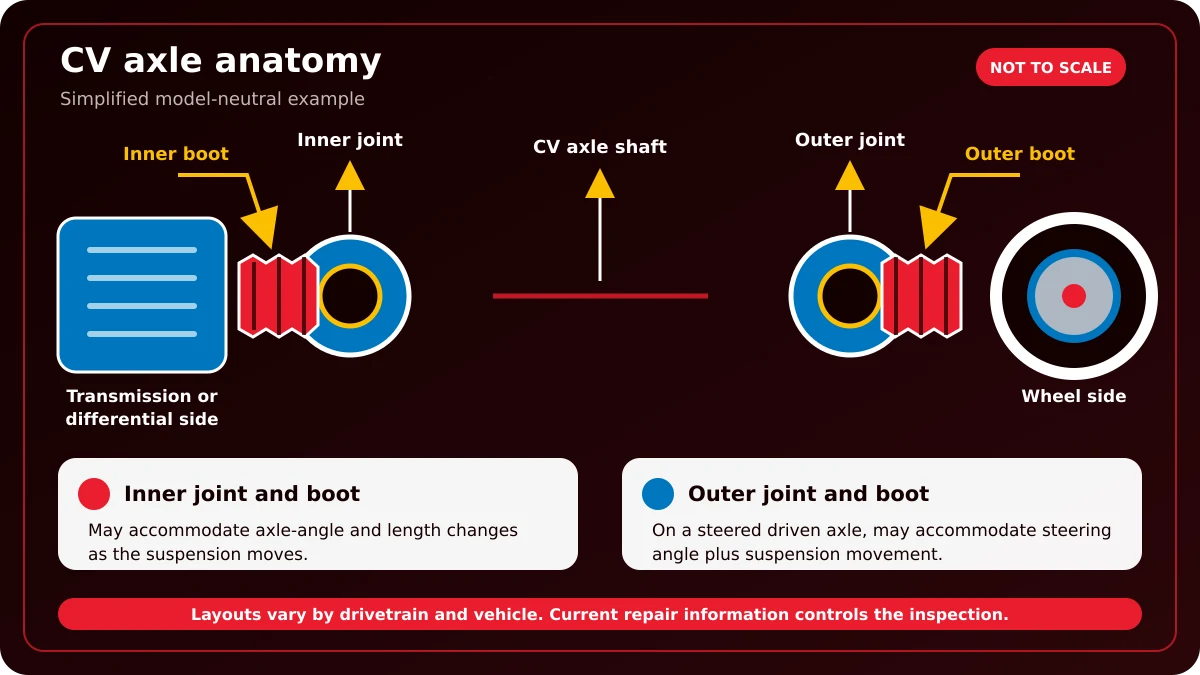
Many driven axles have an inner joint near the transmission or differential and an outer joint near the wheel. Each joint may have its own boot. The joints work at different positions and can use different designs.
| Boot position | Where it sits | Movement it may accommodate |
|---|---|---|
| Inner CV boot | Transmission or differential side of the axle | Changes in axle angle and length as the suspension moves |
| Outer CV boot | Wheel side of the axle | Steering angle on a steered axle plus suspension movement |
These are model-neutral descriptions. Some drivetrains use other layouts, and the terms or service procedures can differ. The vehicle’s current repair information controls the inspection.
Signs a CV boot may be damaged
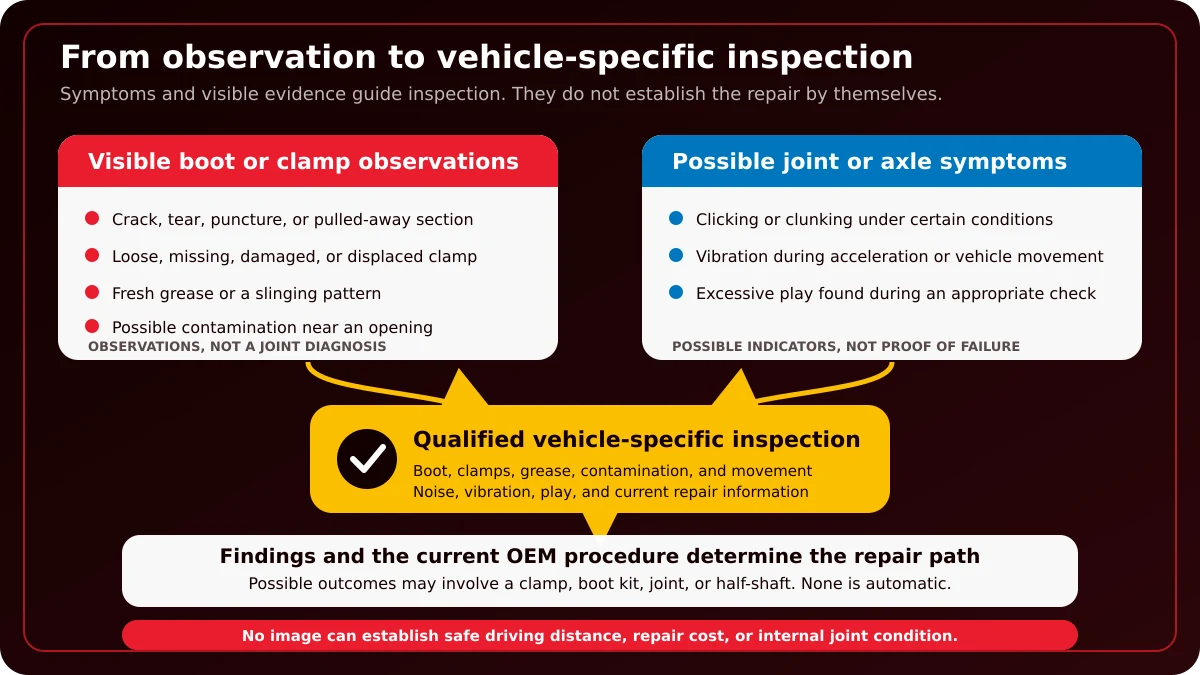
Boot damage may be visible even when no driveline symptom is present. Useful observations include:
- Cracks in the folds of the rubber or thermoplastic boot
- A visible tear, puncture, split, or section pulled away from its seat
- A missing, damaged, loose, or displaced clamp
- Fresh grease around a boot opening
- Grease sprayed in an arc onto the wheel, suspension, underbody, or nearby parts
- Dirt attached to fresh grease around a damaged area
Grease slinging matters because a rotating axle can throw grease away from the opening. The pattern does not show how long the boot has been open or what condition the joint is in.
New driveline noise, vibration, or looseness can mean the issue extends beyond the boot. Those symptoms require diagnosis because they do not identify the boot as the cause.
Grease near the boot does not answer the whole question
Grease near a boot does not establish whether a repair is needed. On the MINI models covered by bulletin 31 01 24, surface buildup is distinguished from cracks, tears, clamp problems, and active grease slinging. Other vehicles require their own repair information.
CV boot damage vs. CV-joint failure
A boot protects the joint, but the boot and joint are separate parts of the axle assembly. Damage to one changes the risk to the other without establishing the joint’s condition.
| Observation | What it establishes | What still needs inspection |
|---|---|---|
| Surface residue with an intact boot and secure clamps | Grease or contamination is visible | Whether residue is active, where it came from, and whether the condition falls within vehicle-specific guidance |
| Crack, tear, loose clamp, or fresh grease loss | The protective seal may be compromised | How much grease was lost, whether contamination entered, and whether the joint has wear or damage |
| Clicking, vibration, clunking, or excessive play | A driveline symptom is present | Whether the CV joint, axle, another driveline component, or a separate fault is responsible |
| Damaged internal tracks or excessive joint wear found during inspection | Internal joint damage is present | Which approved joint or axle repair applies to that vehicle |
GKN’s workshop guide instructs technicians to inspect the joint when a boot needs replacement and to decide whether boot replacement alone is sufficient. It also describes deeper cleaning and component inspection when the joint’s condition cannot be confirmed externally.
Can you drive with a damaged CV boot?
No universal distance or number of days applies. A visible crack, active grease loss, and a new driveline symptom are different findings, so the vehicle-specific condition must guide the decision.
Arrange an inspection after finding a crack, tear, loose clamp, or fresh grease. If the way the vehicle drives changes, follow the owner’s manual and seek qualified guidance.
How a technician checks the boot, joint, and axle
An inspection starts with the driver’s observations and the visible condition of the axle area. The technician may check:
- Inner and outer boots for cracks, splits, punctures, and hardened folds
- Both boot clamps for correct position and retention
- Fresh grease loss and the direction of any spray pattern
- Dirt, water, or other contamination near an opening
- Joint movement, play, noise, and vibration under appropriate conditions
- The axle shaft and nearby components for contact or damage
The joint may need a closer inspection if the boot has been open, contamination is present, or new driveline symptoms appear. The process can involve removal and cleaning. A surface inspection alone cannot reveal every damaged track or internal contact area.
What repair can involve
The repair decision can range from correcting a clamp problem to replacing a boot kit, CV joint, or complete half-shaft. The choice depends on the vehicle, the boot location, grease loss, contamination, joint condition, and the manufacturer’s procedure.
OEM guidance varies. Hyundai TSB 20-DS-001H describes a boot-kit repair for one specified 2020 Sonata DN8 condition, while Volkswagen technical tip 40-13-01SS2 gives different clamp and joint instructions for listed 2012 to 2014 models. Neither procedure applies outside its stated vehicles and conditions.
For concerns beyond the axle assembly, see Big Mission’s engine and powertrain services.
What to record before an inspection
Bring details a technician can use:
- Where the grease or damage appears
- Whether the evidence is fresh or has changed
- When any new driveline symptom occurs and which driving condition accompanies it
- Any recent axle, wheel, suspension, or driveline work
If you find visible boot damage or new driveline symptoms, review Big Mission’s axle and CV-joint inspection and repair information. Record what you observed and let a vehicle-specific inspection determine whether the boot, joint, or axle needs attention.
Visible boot damage and driveline symptoms can have different causes and repair paths. Follow the vehicle owner’s manual and obtain a qualified inspection before making repair or driveability decisions.
Sources
- GKN Automotive, Workshop Tips
- MINI USA, bulletin 31 01 24
- Hyundai Motor America, TSB 20-DS-001H
- Volkswagen Group of America, TT 40-13-01SS2